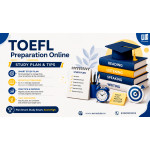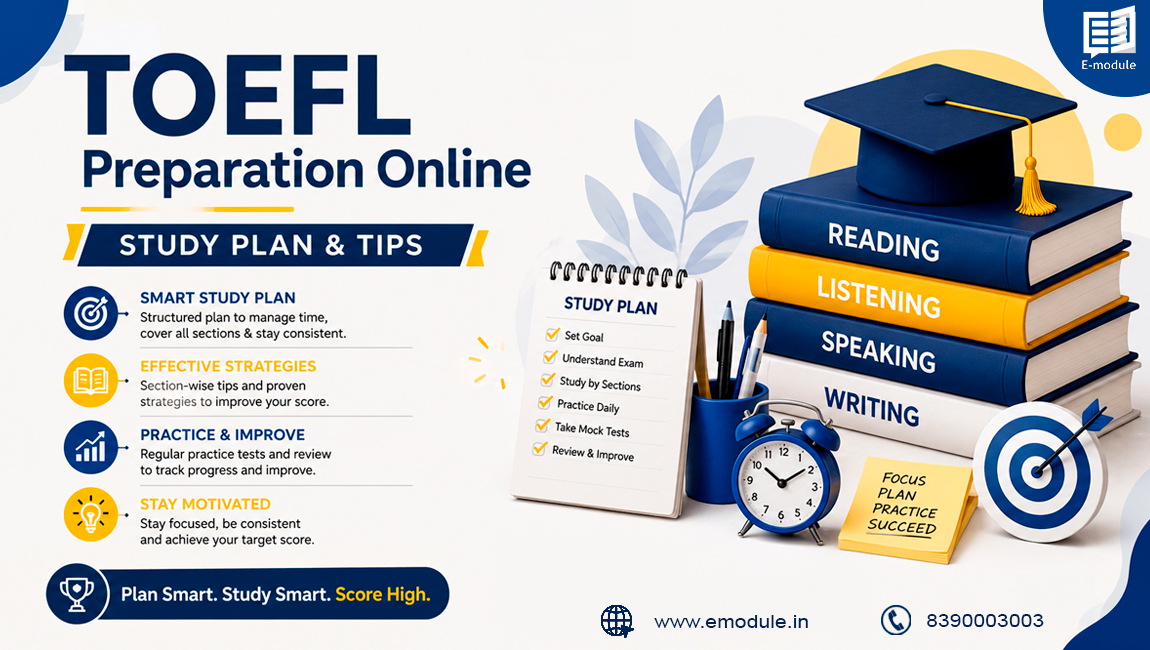
There’s a stage during TOEFL preparation online where almost every student feels stuck.
You study for hours, solve a few questions, maybe watch some Speaking videos online, but deep inside, it still feels like you’re not improving enough. Some students keep changing resources every week. Others spend too much time searching for “best TOEFL study plan” instead of actually practicing.
The strange part is that many students preparing for the TOEFL are already comfortable with English. They can communicate well, understand movies, and attend classes in English — yet they still struggle to reach their target score.
That happens because TOEFL is less about theoretical English and more about performance under pressure.
The test evaluates your ability to read, listen, speak, and write fluently in a short period of time. Additionally, students must feel at ease answering questions in a digital exam setting because the TOEFL iBT is entirely computer-based.
The TOEFL exam currently lasts about two hours and assesses four sections:
Additionally, ETS has announced more recent enhancements starting in 2026, such as speedier score reporting, more communication-focused academic assignments, and adaptive testing components. Realistic mock-test practice is now far more crucial than merely memorising vocabulary lists or reading grammar rules as a result of these changes.
And to be honest, here is where a lot of students start to get confused about being prepared.
Some join expensive classroom programs but still don’t practice enough independently. Some depend entirely on free resources scattered across the internet without following any structure. Eventually, preparation becomes random.
A proper TOEFL study plan usually fixes that problem.
Not because study plans are magical — but because they stop students from preparing emotionally and help them prepare consistently instead.
Most beginners think a study plan means studying all day. In reality, the students who improve steadily are usually the ones following smaller, repeatable routines.
Focus on consistency instead of long study hours.
That’s all.
The difficult part is not creating a plan.
The difficult part is actually following one without getting distracted by too many resources.
For this reason, rather to relying solely on strict coaching schedules, students now prefer flexible online TOEFL preparation. Students who manage college classes, employment, or university applications at the same time have greater control over their schedule thanks to self-paced preparation.
However, flexibility is only effective when students have access to appropriate practice materials.
For example, the Reading section becomes much easier once students stop trying to understand every complicated word in passages. TOEFL reading is more about identifying ideas quickly, managing time, and understanding context under pressure.
Listening creates another common issue.
Most students don’t lose marks because they cannot understand English. They lose marks because their concentration breaks during longer conversations or lectures. That only improves through repeated timed practice.
This is why sectional testing matters more than many students realize.
Platforms like E-module are helping students practice more realistically because learners can attempt individual sectional tests instead of waiting until they feel “fully prepared” for complete mock exams. Since sectional tests start at just ?20, students can practice regularly without spending heavily on coaching or expensive testing packages.
Speaking is usually where confidence drops the fastest.
A lot of students panic the moment the timer begins. Some try memorising answers. Others concentrate too much on challenging vocabulary or accents. However, TOEFL Speaking mostly assesses your ability to express ideas freely and with clarity, fluency, and structure.
Repeated exposure is the only effective method to boost speaking confidence.
That’s why realistic test environments matter.
The E-module offers a free TOEFL trial that helps students experience the actual exam interface before beginning serious preparation. For beginners, this small exposure alone reduces anxiety because the exam no longer feels unfamiliar.
The Writing section creates a different kind of frustration.
Students often write without understanding why they are losing marks. Waiting several days for feedback also slows improvement because by the time evaluations arrive, most learners have already forgotten their thought process during the test.
This is exactly why AI-based evaluation systems are becoming more useful in modern TOEFL coaching online platforms.
E-module uses a purely AI-evaluated system that provides:
That immediate feedback helps students identify repeated mistakes much faster instead of practicing blindly for weeks.
The platform also includes:
which gives students enough variety to experience different question patterns before the actual exam.
And honestly, that familiarity changes confidence levels a lot.
While many students continue to look for sophisticated TOEFL strategies, the majority of score gains typically result from fundamental routines that are regularly followed:
When preparation feels structured rather than disorganised, that process just gets easier.
Ultimately, preparing for the TOEFL does not include studying every internet resource.
It involves selecting a methodical approach, adhering to it regularly, and providing yourself with adequate, practical practice prior to test day.
FAQs
How many weeks are typically sufficient to prepare for the TOEFL?
Depending on their existing English proficiency and consistency, the majority of students may easily prepare in 4–8 weeks.
Is it effective to prepare for the TOEFL online?
Yes, many students today find that structured self-paced learning in conjunction with frequent practice exams works quite well.
What makes TOEFL practice exams crucial?
Time management, focus, confidence, and familiarity with the actual exam setting are all enhanced by mock exams.
Does AI-based assessment genuinely benefit students?
Indeed. Students can immediately detect errors and strengthen their areas of weakness with the aid of instant AI evaluation.
Can novices prepare for the TOEFL with the E-module?
Yes, because students can practise section-by-section based on their ability, the E-module is appropriate for both novice and advanced learners.
Does the E-module provide a free trial?
Indeed, the E-module offers a free TOEFL trial so that students can familiarise themselves with the platform and exam setting before beginning their full study.