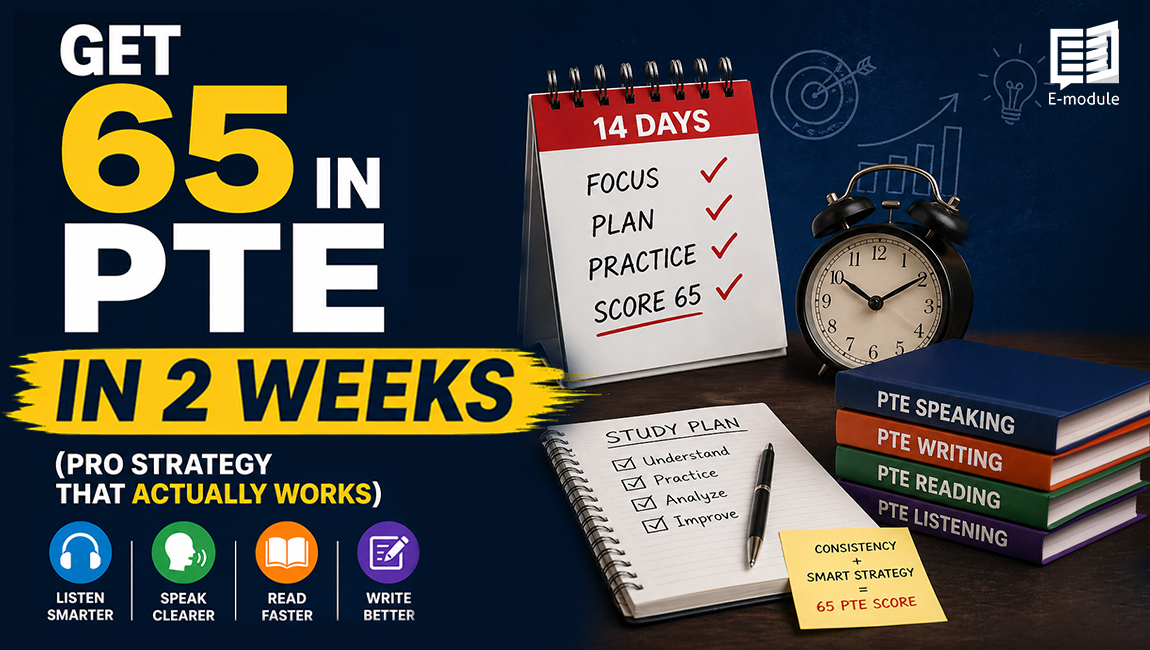
Let’s say you’ve got two weeks left and your target is to get 65 in PTE. At this point, most students either panic or start doing everything at once. And that’s exactly where things go wrong.
It’s not that people don’t work hard. They do. But they end up putting effort in areas that don’t really move the score. So even after hours of practice, the result stays somewhere in the low 50s. That’s frustrating, but also very common.
The thing is, PTE doesn’t work like a typical English exam. Every question is not equally important. Some tasks quietly carry more weightage because of the way scoring works. One answer can affect multiple sections at once—speaking, listening, sometimes even reading. If you don’t pay attention to that, preparation starts feeling like guesswork.
But once you understand this part, things become a lot clearer. You don’t need perfect English. You just need the right focus. And yes, even in two weeks, moving towards 65 becomes possible.
Can You Pull Off 65 in Just Two Weeks?
Honestly, yes—but only if your approach changes.
Many students think doing more will automatically improve their score. In PTE, that’s not always true. It’s more about doing the right things again and again.
The exam has also changed slightly over time. New tasks like Summarize Group Discussion and Respond to a Situation have been added. These are not memory-based. You’re expected to respond naturally. So if you’re still relying on fixed templates everywhere, it might not help as much as before.
The test itself is shorter now—around two hours, with roughly 52–64 questions. Speaking and writing come first, then reading, and listening at the end. A score of 65 usually falls in the upper-intermediate range, which is acceptable for most study or visa purposes.
So instead of trying to master everything, it makes more sense to focus on what actually contributes more.
Understanding Where the Marks Actually Come From
This part is often misunderstood.
In PTE, scoring is not isolated. It’s connected. One task can influence more than one section. For example, Repeat Sentence doesn’t just test speaking—it also affects listening. Read Aloud links reading and speaking. Retell Lecture again overlaps between listening and speaking.
Because of this, some tasks naturally become more important. If you look at it practically, areas like Repeat Sentence, Read Aloud, Reading Fill in the Blanks, Listening Fill in the Blanks, and Retell Lecture play a major role in improving scores. Students who practice these regularly tend to see better progress.
On the other hand, questions like multiple-choice or short answers don’t contribute much. Spending too much time on them doesn’t really add value. It’s better to first build strength in the important tasks and then gradually cover the rest.
Your No-Fluff 14-Day Plan: 2–3 Hours a Day
Start with Day 1 by giving a full mock test. Don’t overthink it—just take it and see where you stand. The idea is to understand your weak areas clearly.
After that, keep your daily routine manageable. Around 2–3 hours is enough if you stay consistent. You can roughly divide your time—more focus on speaking, and some time for reading and listening, followed by reviewing mistakes.
In the first week, the goal is to get comfortable with key tasks. Spend a few days on Repeat Sentence and Read Aloud. Don’t chase perfection—just try to maintain a steady flow. Then shift towards Reading Fill in the Blanks and Listening Fill in the Blanks. Accuracy matters more here, so take your time understanding context.
Towards the end of the week, include Retell Lecture and Describe Image. Keep your responses simple and within time limits.
In the second week, things should feel more practical. Start working on tasks like Summarize Group Discussion and Respond to a Situation. Try to answer them naturally. Begin attempting sectional tests, and gradually move towards full mock tests.
In the last couple of days, focus on timing and consistency. Don’t overload yourself. The final day should be light—just revision and proper rest. If your score reaches around 55 during practice, that’s usually a good sign.
Speaking & Writing: Keep It Clear and Simple
In speaking tasks, fluency matters more than accuracy. In Repeat Sentence, even if a few words are missed, a smooth response works better than stopping repeatedly.
In Read Aloud, just keep your pace normal. No need to rush. For Describe Image, say what you see—main points are enough. Retell Lecture is more about confidence than perfect content.
For newer tasks, like group discussions or situation responses, try to sound natural. If it feels memorized, it usually doesn’t work well.
In writing, keep things simple. For Summarize Written Text, one clear sentence is enough. For essays, 200–250 words with a basic structure works fine. No need to complicate ideas.
Reading & Listening: Stay Practical
Reading Fill in the Blanks improves with practice. Over time, you start recognizing patterns. It’s better not to spend too much time on difficult MCQs.
In listening, staying focused is important. Fill in the Blanks needs attention and quick typing. Highlight Incorrect Words requires you to follow the audio closely.
Interestingly, as speaking improves, listening often improves too.
Common Mistakes That Affect Scores
Some mistakes are very common. Overusing templates is one of them. Speaking too fast or unclearly is another. Spending too much time on low-impact questions also slows progress.
Another thing people ignore is reviewing mistakes. If you’re not checking where you went wrong, improvement becomes slow.
Where Practice Actually Helps
The way you practice makes a difference.
If your practice doesn’t feel like the real exam, it becomes difficult to adjust on test day. That’s why using a proper platform can help.
On emodule, you get a setup that feels close to the actual exam. It includes AI-based scoring, so you can see your performance instantly. There are enough sectional tests for daily practice, along with 5 full mock tests.
It also highlights areas where you need improvement, like fluency gaps or listening mistakes. That makes your preparation more focused.
Final Advice
If your target is to get 65 in PTE, don’t try to do everything. Just stay consistent with the right things.
“PTE is not about complex English. It’s more about how clearly you understand and respond. If you stay consistent with the right tasks and keep your preparation simple, improvement becomes much easier over time.”