If you’re running a coaching institute, you’ve probably seen this yourself — students don’t usually complain about teaching. They sit in class, take notes and everything looks fine. But the actual issue usually comes closer to the exam, when students start feeling underprepared or unsure about their practice level. And honestly, that’s where most institutes miss something important, which is not teaching, but the right kind of practice. This is exactly where a proper TOEFL mock test software for institutes starts to matter more than anything else.
The thing is, TOEFL is not like traditional exams. It’s completely computer-based, and that changes everything. If a student is only studying from notes or solving questions casually, they’re not actually preparing for the real situation. There’s timing involved, there’s pressure and there’s a certain way the exam feels on screen. If they don’t experience that before the actual test, they take time to adjust — and that affects their performance. That’s why having a structured TOEFL practice platform is not just useful anymore; it’s becoming a basic requirement.
Now this is something we kept hearing while working with different institutes. Not one or two — almost everyone had the same issue. They had students, they had teachers, but they didn’t have a proper system where students could sit and practice like it’s the real exam. Some were using PDFs, some were taking manual tests and some had tools that were either too complicated or not really helpful. So instead of overbuilding things, the idea was simple — create something that actually works in daily use. That’s how E-module’s TOEFL test software came into place.
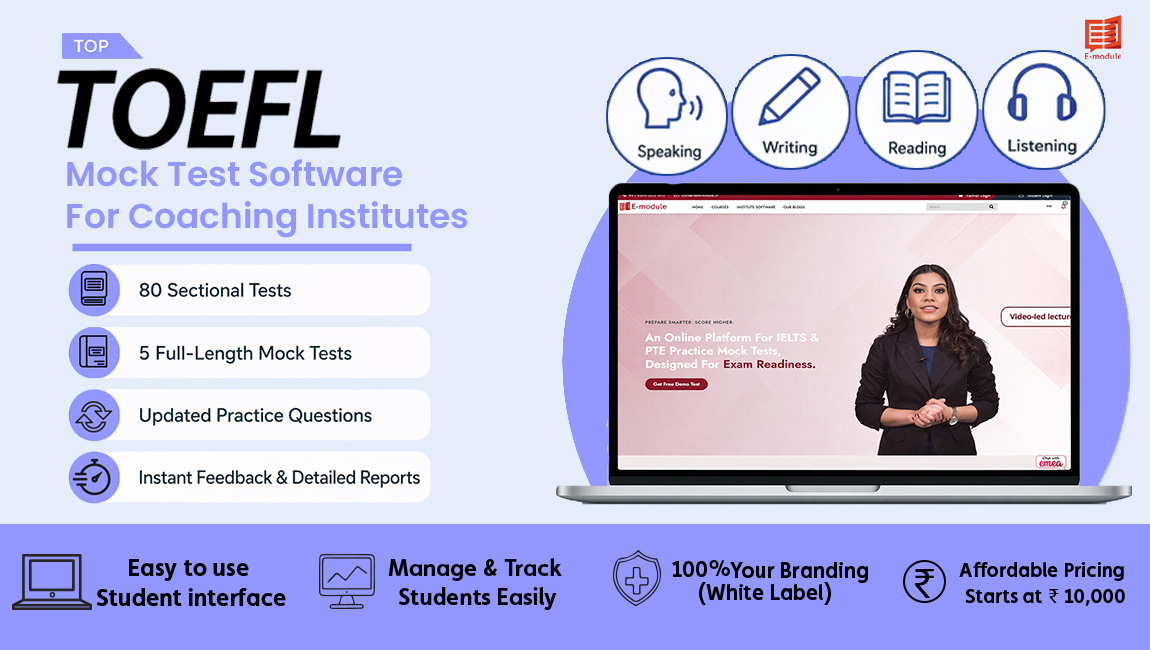
From a student’s point of view, the experience is kept simple. When they log in, they don’t feel lost. They usually begin with smaller sections — listening, reading, writing and speaking — and slowly get comfortable. Once that base is built, they move towards full tests. At present, the platform offers 80 sectional tests, 5 full-length mock tests and continuously updated practice questions, which gives students enough practice to gradually understand the exam pattern and improve with consistency. Another helpful part is the quick feedback that helps the students check their performance right after attempting the test, and see where they made mistakes, and work on them without delay. This simple cycle of attempt, review and improvement is what actually helps them progress.
From your side as an institute owner, it doesn’t become another headache. You don’t need any technical expertise to handle it. The dashboard is simple — you can add students, assign TOEFL preparation, and monitor their progress easily, all in one place. Also, an important detail — students only see your institute’s branding, so the entire experience still feels like your own platform.
Now, coming to the part everyone thinks about — cost. Many institutes initially hesitate, assuming that such systems might be expensive or difficult to manage. But it’s kept straightforward. Our B2B partners can begin with a ?10,000 package, and on an average, the TOEFL course on our portal costs around ?699. This allows you to start with a smaller batch, understand how it fits into your institution’s setup, and then scale gradually without much financial pressure.
The shift towards such platforms is happening not because it sounds modern, but because it addresses a real gap in preparation. You don’t have to build anything from scratch; students get proper structured practice, and over time, their confidence improves. And when confidence improves, results follow. That’s usually how institutes grow — not by doing something extraordinary, but by fixing what was missing.
In the end, teaching will always stay important. That part doesn’t change. But for exams like TOEFL, consistent and structured practice is what completes the preparation. And having the right TOEFL mock test software for institutes simply makes that process easier — for both you and your students.
If you want to see how it actually works, you can check it here: emodule