Over the past few years, student choices about English proficiency examinations have evolved quite quickly.
In the past, the majority of students preparing for study abroad concentrated largely on the TOEFL or IELTS. However, more and more candidates are now actively selecting the Duolingo English Test (DET), particularly students preferring a quicker, more flexible, and more economical testing process.
That change is becoming unavoidable for coaching centers.
Today's students desire convenience. They desire faster admissions processes, online accessibility, quicker outcomes, and preparation methods that feel contemporary rather than antiquated. Students who are accustomed to digital learning environments will naturally find the Duolingo English Test appealing because it is entirely online and adaptive.
To be honest, the attraction makes sense.
DET provides a far more flexible experience than traditional English tests, which could include travel, set test dates, or lengthy wait times for results. Students can take the test online from home, get their results fast, and utilise their results to apply to thousands of colleges around the world.
Many IELTS, PTE, and TOEFL coaching centers are also branching out into DET preparation due to this increasing demand.
However, including a few practice questions into an already-existing course is not the only way to introduce Duolingo preparation.
Compared to traditional English tests, the Duolingo exam operates somewhat differently.
Because it employs adaptive testing, the difficulty of the questions varies based on how well students perform on the test. This means that rather than merely studying static worksheets or arbitrary word lists, students should be exposed to considerably more realistic mock-test scenarios.
And this is precisely the point at which many coaching centers start to experience operational strain.
Traditional mock-test handling simply does not fit modern DET preparation very well.
Evaluating speaking and writing manually takes enormous time. For larger student batches, trainers frequently find it difficult to give prompt feedback. Although many institutions still rely on delayed evaluations or disjointed systems that hinder the learning process, students anticipate a quick performance review.
There’s also the branding issue.
A lot of institutes preparing students for DET depend on third-party practice portals that display external company branding. From a business perspective, that weakens the institute’s own identity and creates a less professional student experience.
Building custom software internally is another challenge altogether.
For most small and medium coaching businesses, developing independent Duolingo mock test software is expensive, technically demanding, and difficult to maintain consistently. Even institutes with strong teaching faculty often struggle when it comes to software infrastructure and automated assessment systems.
That is one reason AI-powered mock-test platforms are becoming increasingly important in the DET preparation industry.
Students preparing for adaptive exams now expect:
Coaching centers that cannot provide those experiences often appear outdated compared to digitally equipped competitors.
This is where platforms like E-module are helping institutes modernize preparation without creating operational complexity.
Instead of functioning as a generic student portal, E-module is designed as a complete B2B DET preparation infrastructure for coaching institutes and study-abroad businesses.
One of the most useful aspects is the completely white-labeled portal system.
For institutes trying to strengthen their own brand identity, this matters far more than people assume. Students prefer platforms that feel organized and professionally managed by their coaching center directly instead of being redirected to unrelated third-party systems.
At the same time, the platform also addresses the academic side of DET preparation.
Since adaptive familiarity is critical for Duolingo success, E-module provides 25+ full-length mock tests across multiple difficulty levels including:
This allows students to gradually adjust to changing question complexity instead of practicing repetitive fixed-level exercises.
That realistic progression becomes extremely useful because the actual DET exam constantly adapts according to performance.
Another challenge coaching centers often mention is evaluation consistency, especially for speaking and writing tasks.
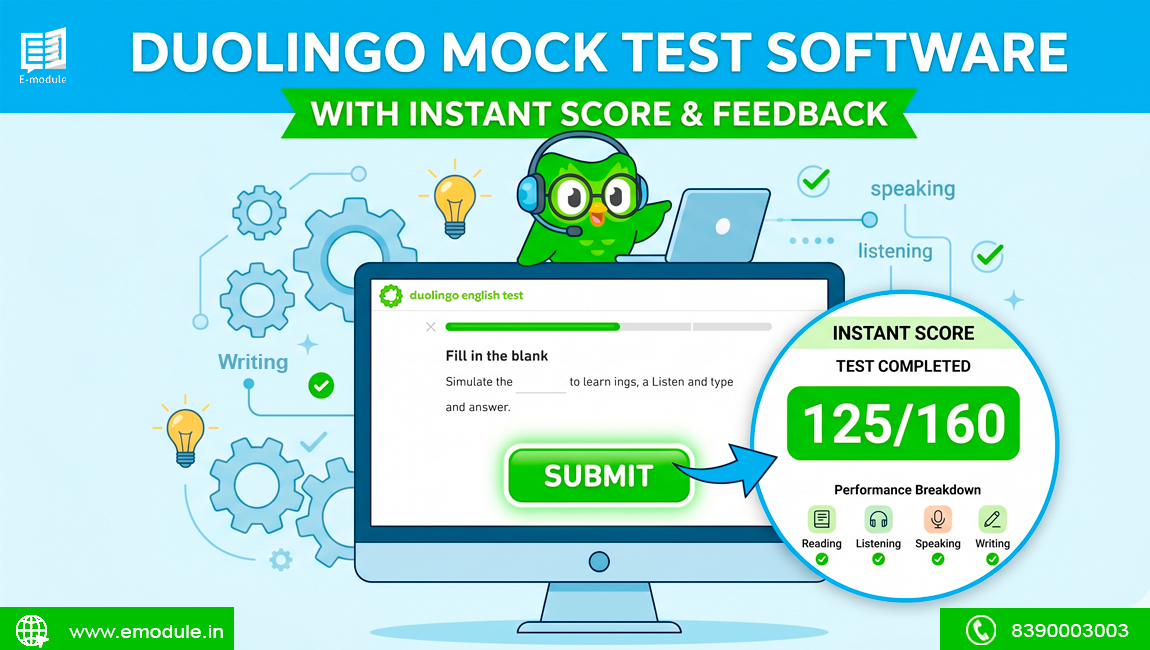
Manual assessments vary between trainers and become difficult to scale as student numbers grow. E-module’s complete AI-evaluation system helps institutes solve this issue more efficiently by generating instant scores and exam-like TRF reports immediately after every attempt.
Instead of waiting days for feedback, students receive performance analysis instantly, which keeps preparation momentum much stronger.
That immediate feedback loop is becoming a major expectation among students preparing for modern digital exams.
The platform also continuously updates practice questions, which helps institutes avoid outdated preparation patterns. Since English proficiency exams continue evolving, static content libraries are no longer enough for long-term preparation quality.
Another reason why many coaching businesses are moving toward scalable AI-powered systems is affordability.
It takes an important financial commitment, technical teams, and continuous maintenance to develop independent software infrastructure. With nominal B2B pricing starting at about ?10,000, E-module keeps the process affordable, enabling even smaller institutions to provide competent DET preparation solutions without paying excessive operating costs.
And honestly, this larger transition toward digital preparation is only accelerating.
These days, students evaluate educational institutions based on both the whole learning experience and the quality of the instruction. Study-abroad candidates are naturally more trusting of a coaching center that provides adaptive practice, rapid scoring, realistic simulations, and contemporary digital accessibility.
That does not mean technology replaces trainers.
In reality, strong trainers become even more effective when repetitive evaluation work becomes automated properly. Faculty can devote more time to mentoring, strategy development, and individualised coaching rather than spending endless hours manually reviewing mock exams.
The industry seems to be moving in the direction of striking a balance between scalable AI infrastructure and human mentoring.
And for coaching institutes planning to expand DET preparation seriously, investing in dependable Duolingo practice test platform systems is no longer just an optional upgrade. It is slowly becoming part of the foundation of modern language-training businesses.
Platforms like E-module are helping institutes bridge that gap by combining:
into one scalable preparation system designed for the realities of today’s DET market.
FAQs
Why is the Duolingo English Test becoming increasingly popular among students?
Because DET is entirely online, more accessible, less expensive, and yields faster results than many traditional English tests, students prefer it.
Why is mock-test familiarity important for DET?
Since DET uses adaptive testing, students perform better when they regularly practice in realistic online exam environments.
What problems do coaching institutes face with manual DET mock tests?
Manual evaluations take time, especially for speaking and writing tasks. Delayed feedback also affects student learning speed and operational efficiency.
What is the benefit of instant score generation?
Instant scoring helps students analyze performance immediately and continue improving without waiting days for evaluation results.
Why do educational institutions favour preparation portals with white labels?
In addition to offering a more polished student experience, white-labeled technologies enable institutions to preserve their own branding.
For coaching centers, is AI-based DET evaluation trustworthy?
AI-based systems help institutes deliver faster, more scalable, and more consistent evaluations while reducing manual workload significantly.