Since the PTE is entirely computer-based, preparation has always been linked to technology. Digital platforms have been used by institutes for years. However, there are now many different requirements for preparatory software. Previously, simple practice portals and basic mock exams were considered sufficient. Students now require systems that closely resemble the real exam experience, from real-time feedback and AI-based scoring to updated question trends and exam-like performance analysis.
Students are being tested on more than just their English proficiency these days. Additionally, their ability to function comfortably in a computer-based environment is being examined. Everything counts, including timing, fluency, pronunciation, typing speed, and speaking pauses. And this is precisely the point at which a lot of institutions quietly struggle.
Even if a student has impeccable grammatical comprehension, they may nevertheless receive lower grades if they pause when speaking. Another student might be aware of the solution but find it difficult to type under duress. Some people do well in class conversations but become anxious when the microphone begins to record.
These learners are often not poor English speakers.
They just don't know how the exam setting works.
This is one reason why AI-based PTE mock test software, AI PTE mock test, and modern PTE practice software have started becoming more important for coaching institutes, study abroad consultants, and language academies. Educational institutions are gradually discovering that when students' everyday preparation truly feels like the actual exam, they do better.
Honestly, that change was inevitable.
The Real Issue with Traditional Mock Practice
Many institutions still use manually reviewed speaking sessions, printed worksheets, or PDFs to prepare their students. That strategy has one significant flaw, but it is not entirely flawed.
The PTE exam itself operates differently from a classroom.
The real test is fully computer-scored. Students type continually on the screen, talk into microphones, answer within time constraints, and receive results produced by automated algorithms. Many students, however, never practise in those similar settings throughout preparation.
As a result, the first actual exposure frequently occurs on exam day.
That usually affects confidence.
For example, trainers often notice students rushing while speaking because they are nervous about the recording time. Others pause too much because they are trying to sound perfect. Some students struggle more with screen navigation and typing speed than with English itself.
These things sound small individually, but together they influence scores heavily.
This is the point at which a suitable PTE mock test platform becomes truly helpful—not because it takes the role of instruction, but rather because it gives practice a sense of realism.
How Students Can Actually Improve with AI-Based Practice
One interesting thing about PTE preparation is that students usually improve faster when feedback becomes immediate.
In traditional setups, a student may attempt a mock today and receive corrections much later. By then, the student has often forgotten where the actual mistakes happened. Naturally, improvement becomes slower.
With AI scoring for PTE and advanced PTE scoring software, that cycle changes completely.
Students can attempt a test and immediately review their performance. They quickly understand where they paused too much, where pronunciation dropped, or where typing mistakes affected the score. They begin to practice with mindfulness rather than randomly.
Over time, that creates noticeable consistency.
A trainer from a coaching institute recently explained this quite practically. Earlier, students kept repeating the same fluency mistakes for weeks because manual correction took time. After shifting to AI-based evaluation, students started correcting those patterns much earlier simply because they could see the issues immediately after every attempt.
That kind of instant feedback matters more than people think.
Why Institutes Are Moving Towards AI-Supported Systems
Most institutes today are not searching for flashy technology. They simply want preparation systems that reduce manual workload while improving student outcomes.
A structured PTE coaching software helps in exactly that area.
Instead of manually checking every speaking response or managing multiple practice systems separately, institutes can offer students a single platform where practice, testing, scoring, and performance tracking happen together.
From the student side, the experience also feels smoother. Students log in, practise regularly, review results instantly, and gradually become more comfortable with the actual exam pattern.
And honestly, students now expect this level of preparation.
Most learners are already used to digital learning environments. They naturally prefer systems that provide quick results, flexible practice, and exam-like simulation rather than delayed manual corrections.
What Institutes Should Look for Before Choosing a Platform
Not every PTE practice platform offers meaningful preparation. Some systems provide large question banks but lack proper evaluation quality or realistic exam simulation.
The platforms that genuinely help students usually focus on practical preparation rather than just quantity.
Institutes should ideally look for:
Students find it simpler to cope with pressure later on if the practice setting feels more like the actual exam.
How E-module Supports Modern PTE Preparation
The E-module was designed keeping this exact transition in mind.
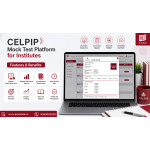
The platform currently offers preparation support for both PTE Academic and PTE Core. Students get access to more than 80 sectional tests, over 1200 practice questions, and 5+ full mock tests designed around actual exam patterns.
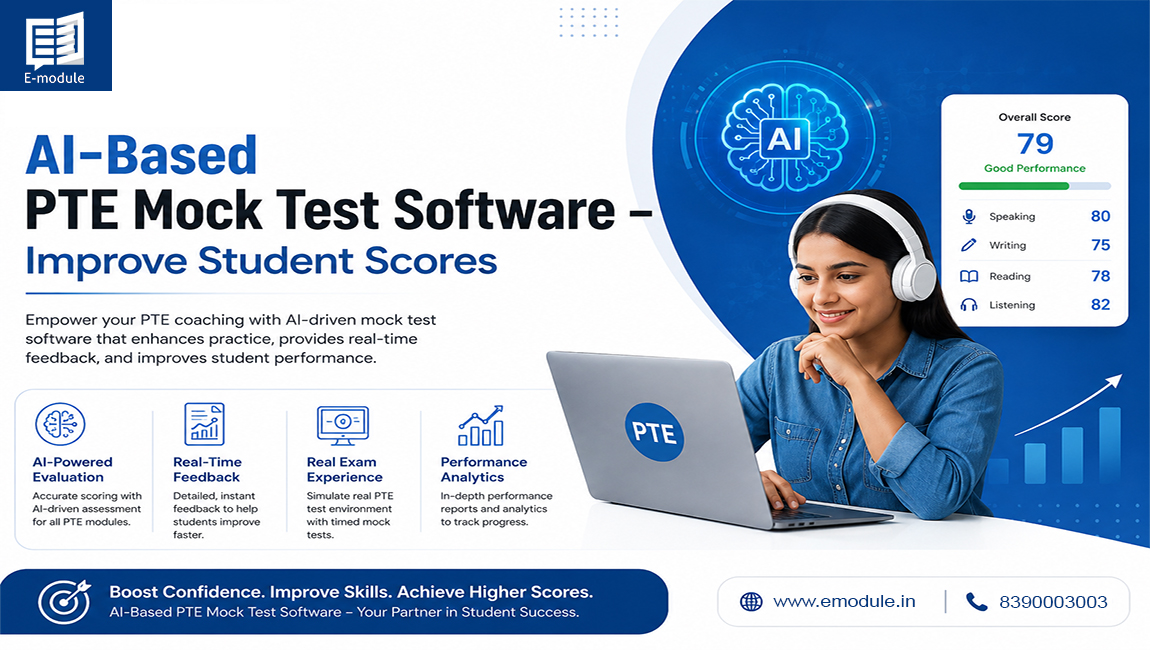
One thing students often find helpful is the immediate reporting system. As soon as a test ends, the platform generates AI-evaluated scores within seconds along with exam-style TRF reports. This allows students to identify weak areas quickly instead of waiting for delayed feedback.
For institutes, the system also makes day-to-day management easier. Trainers can monitor progress, assign practice, and track student performance without constantly depending on manual evaluation processes.
And perhaps most importantly, students gradually become comfortable with real-time speaking, typing, timing, and screen-based navigation long before the actual exam day arrives.
The Future of PTE Preparation Is Clearly Becoming More Digital
The language testing industry is changing rapidly, and student expectations are changing with it.
Today’s learners expect:
Flexible preparation
Computer-based practice
Fast feedback
Realistic mock environments
Smarter performance tracking
Institutes that adapt early to these expectations usually create stronger preparation systems overall.
This does not imply that technology will take the role of educators.
Communication support, strategy advice, and human mentoring are still very important. However, preparation is becoming more organised, scalable, and useful for both institutions and students due to AI-supported solutions.
And that balance is probably where modern PTE coaching is heading now.
Concluding Remarks
It takes more than just grasping English concepts to do well on the PTE these days. Additionally, students must be familiar with how the exam functions in an actual computer-based setting.
For this reason, solutions that provide AI-supported practice and automated PTE evaluation are becoming more and more useful for study abroad companies and coaching centers.
With its AI-powered preparation ecosystem, E-module offers a workable
alternative for institutions wishing to deliver organised and exam-focused
preparation through a contemporary digital setting.
Visit the E-module to learn more.
FAQs
What is AI-based PTE mock test software?
It is a digital platform that evaluates student performance using AI systems similar to the actual PTE scoring method.
Why does AI scoring help students improve faster?
Because students receive instant feedback on fluency, pronunciation, pauses, and timing instead of waiting for manual corrections.
Is computer-based practice important for PTE?
Yes. Since PTE is fully computer-based, students usually perform better when they practise in a similar environment regularly.
Can institutes use one platform for both PTE Academic and PTE Core?
Yes. Platforms like E-module support both formats separately with dedicated practice and mock tests.
What features matter most in a PTE mock test platform?
Real exam simulation, AI evaluation, sectional tests, detailed reports, and updated question patterns are some key features.
Does AI replace trainers in PTE coaching?
No. AI helps with scoring and analysis, while trainers continue guiding students through strategy and improvement areas. br>